Worship
Book / Produced by partner of TOW
Originally to worship meant simply to “attribute worth”; worship could be directed to God or to a person to whom honor and respect should be given. In classical Christian writings it referred primarily to our chief goal in life, that is, rendering grateful homage and dedicating our lives to God rather than to any other person or object. This included a person’s private religious devotions. The word has also been one of the main terms used for public religious services: many church notice boards list the hours for “divine worship.” In charismatic circles the word has mainly come to signify the time of extended praise in church, generally led by a “worship team.” In popular speech and song the word is frequently used of any extraordinary expression of devotion, for example, a person or group may “worship” a sports team or rock star, money or power. In some places the word is even used as a form of address, as to a judge in a law court or to an officeholder in a secret society. From a biblical point of view there are legitimate and illegitimate, acceptable and unacceptable, objects of worship (Genesis 4:3-7; Isaiah 1; Romans 14:17-18; Hebrews 12:28-29; Hebrews 13:16). Discernment is necessary to distinguish true from false objects of worship.
People’s feelings about what takes place in church services vary greatly. Some regard such corporate worship as primarily a duty; others as a delight. For some it is chiefly a matter of feeling inspired by or intimately connected to God, for others of being instructed or motivated to action. An increasing number of people today find traditional church services boring and irrelevant. This is particularly true of the younger baby-buster generation but also of many seekers, inquiring about or returning to church. Some find new styles of charismatic or contemporary worship appealing and uplifting. Disputes about appropriate and inappropriate styles of worship have divided many congregations, generally along age lines or according to different views of the Holy Spirit. Surveys of congregations across a wide denominational spectrum, such as those conducted by the Search Institute in Minneapolis some years ago, found that corporate worship is generally regarded as an oasis or refuge from workday demands, rather than as a base camp for equipping members to integrate faith and everyday life. This is why even many committed believers find churchgoing disappointing and unempowering. Perhaps part of the problem is that our definition of worship is too narrow.
Biblical Worship: Acknowledging and Serving God Everywhere
In the Old Testament it is God who initiates the worshipful response of the people by revealing his divine name, rescuing Israel from its oppressors and establishing a covenant with them. The people acknowledge this by attending the temple, offering sacrifices and participating in the annual festivals. When they do this—as individuals, as families or as a nation—they do so preeminently at holy places (the tabernacle and later the temple), at holy times (annual festivals and the sabbath), with holy people (priests and Levites) and with holy sacrifices (clean and unclean animals). Whole sections and books of the Bible—especially from Exodus to Deuteronomy—are given over to instructions about these.
Yet the most important festival of the year, the Passover, takes place in homes and is presided over by the head of the household. Also, respect to God could be given by such ordinary actions as becoming silent or making a simple gesture. Meanwhile, reference to the whole people as “a kingdom of priests and a holy nation” (Exodus 19:6) suggests that the whole of the people’s life was to be brought into the service of God and offered as worship to God. To this end, God gave the Law, which contained social and civic as well as cultic provisions. Despite many prophetic criticisms of Israel’s public and private worship of God and the exile of the people as a judgment for their disobedience, at the heart of their hope lies a restored temple in a purified land, one to which people from the whole earth will make worshipful pilgrimage (Ezekiel 40-48).
In the New Testament the sacrificial system, temple and priesthood—which kept open the lines of communication between God and the people despite their disobedience—are replaced by the sacrifice, holiness and priesthood of Christ (John 2:19; Hebrews 10:1-18). The provisions of the Law, giving guidance on how the people can live obediently before God, are moved into the background, and their place is taken by the example of Christ and fruit of the Spirit (Mark 2:28; Galatians 5:22-26). No longer is it necessary to worship God corporately in special places, for as Spirit God is present everywhere (John 4:23-24), and ordinary homes became the most common meeting places of the church (for example, Romans 16:5). No longer is it necessary to observe the annual festivals or the sabbath, for now all days and times are equally holy in God’s sight (Col. 2:16-19), even if it is particularly appropriate to gather on the first day of the week (1 Cor. 16:1-2).
Many Old Testament words for the sacrificial worship in the temple also appear in the New Testament. But apart from a few references to the pagan cult (Romans 1:25) or to Jewish worship (Romans 9:4), these are used only metaphorically to refer to such things as proclaiming Christ (Romans 15:16), praising God (Hebrews 13:15), dedicating lives (Phil. 2:17), exercising faith (Phil. 2:17), sharing fellowship (Phil. 2:25) and charitable giving (2 Cor. 9:12). It is in performing such services in Christ’s name and for Christ’s sake that we please God and therefore worship God truly (Romans 14:18).
Worship is something anyone can do, anyplace and anytime. So we find words associated with worship are also used of people’s service to society at large (even of the actions of unbelievers if they do what God wishes; Romans 13:7). Believers are encouraged to serve Christ and to please God in every setting, such as their daily work (Col. 3:22-24), family life and marriage (Col. 3:18-20; Ephes. 5:21), caring for the needy (Matthew 25:45), providing hospitality (Hebrews 13:2), acting justly and compassionately (James 1:27). Indeed, our spiritual worship involves nothing less than offering up our whole lives to God so that all we do is in conformity with God’s character and standards rather than with the attitudes and values of the world (Romans 12:1-2). This means that we do not move in and out of worshiping God when we go to church on Sundays but are always worshiping God and just doing so well or badly, consciously or unconsciously.
The only thing that distinguishes our coming together in church is that when we do so, we are worshiping God together as a body of God’s people, whereas most of the time we are worshiping God on our own or with our families and friends. When we do meet together, it is, not only our singing together that is worship, but everything that we do—greeting one another as we arrive, learning from the Scriptures, sharing news or announcements, singing praises or making prayers, sharing the Lord’s Supper and visiting over coffee and cookies after the service. Indeed, for the early Christians having a common meal together was a regular part of their weekly corporate worship. When we are in church, the quality of our worship is not correlated to the intensity with which we focus upon God and feel God’s presence. Instead of closing our eyes and concentrating upon God, as some do today, we are encouraged to keep our eyes open and actually “speak to one another with psalms, hymns and spiritual songs” (Ephes. 5:19), recognizing that encouraging and exhorting each other, receiving instruction and advice from one another (Col. 3:16; Hebrews 10:24-25), are among the most worshipful activities. For in doing this, we discern the presence and communication of God in and through each person who is present.
Worship as Life Orientation: A Duty and a Delight
At the heart of the idea of worship is our relationship with God. All creation declares the glory of God unintentionally just by being itself (Psalm 19:1). But human beings uniquely can choose to bless God; indeed, we are obligated to do so. The fundamental way the Bible describes our relationship with God is the covenant, that binding personal relationship by which two parties (in this case God and people) belong together forever. The covenant starts with the promise that God has selected, adopted and saved the people (Exodus 19:4-6) making them a “treasured possession.” God promises presence, community and a place to belong. The covenant itself is unconditional, founded as it is on the promise, but the blessings of the covenant (the land, the continuance of the people and the ultimate blessing of the Gentiles) are conditional upon obedience to its obligations. These obligations involve (1) a lifestyle of behavior appropriate for God’s covenant people (embodied in the Ten Commandments) and (2) a lifestyle of blessing God (embodied in the temple worship and festivals). In other words, people in right relation to God live faithfully and bless God continuously. To live a holy life (as the Pharisees did in Jesus’ time) but not to express love to God is to break the covenant, even though no grave breach of it is committed. This same failure to bless breaks the covenant of marriage: staying in it ungratefully (like a spouse remaining faithful in a difficult marriage but only complaining about it) still breaks the covenant because there is no blessing of the partner.
In the new, literally “renewed,” covenant in Christ, the covenant is incarnated (in the life and ministry of Jesus), universalized (to include Gentiles) and internalized (through the indwelling Spirit that motivates us from within). All this was foretold under the old covenant but has now become a reality. This renewed covenant still carries the twin obligations of faithful living and grateful blessing. But these are no longer obligations imposed from the outside; they are inspired from the inside as God gives us the power to fulfill them and does so in a way that makes obedience a pleasure. In Jesus’ reflection on John 17 we gain a glimpse of the internal worship life of the triune God. Father, Son and Spirit bring glory to each other, go out of themselves in love for each other and eternally delight in one another. During Christ’s earthly ministry we have a sacred hint of this in his spontaneous worship when “full of joy through the Holy Spirit” (Luke 10:21), Jesus thanked and blessed the Father. So for God’s people worship is not a desperate effort to cross the infinity of time and space and bring honor to God; it is being taken into the continuous worship that goes on within the Godhead. It is modeled and inspired from above, not created and worked up from below.
Some people have trouble blessing God because they feel that God has not blessed them. Like Naomi, they feel that “the Almighty has made my life very bitter” (Ruth 1:20). The roots of this go very deep, as deep as the original sin in the Garden of Eden. That first sin was not eating the forbidden fruit but turning away from our fundamental posture of gratitude to and reverence of God (compare Romans 1:21) to allow a root of bitterness to slip in. This had its source in the serpent, who insinuated that God was holding back some blessing from the man and the woman (Genesis 3:1). Bitterness is not caused by circumstances but by a spiritual choice. Do we trust and love God enough to be content? Further, lapsing into self-pity often comes from a shortsighted faith; God is able to bring good out of all things and turn even the curses experienced in this life into blessings. If not in this life (as happened with Naomi), God will ultimately bless us totally through the resurrection of our bodies and our living in the new heaven and earth. It is here that God’s promises of presence, community and place reach their full consummation.
“Count your blessings” is an ancient saying containing a crucial insight: being blessed is a matter of perspective, of worldview, of spirituality. So the frequent self-exhortation the psalmist utters—“Bless the Lord, O my soul, and all that is within me, bless his holy name” (Psalm 103:1 NRSV)—is exactly what people need to do in their covenantal relationship with God. If there is no blessing, there is no faith and no joy. When we worship, we literally enjoy God, delight in God, play with God, relish God, bring pleasure to God. C. S. Lewis once said that in commanding us to worship, God is inviting us to enjoy him. Paradoxically, while worship, like play, is a “waste of time” because it does not accomplish anything, worship does actually affect God. It is a truly awesome thing that worship makes a difference to God, actually blesses God.
But worship, as we have already seen, is much more than worship services. We also bless God by transforming all aspects of everyday life into a spiritual ministry to others for God, seeking to live according to God’s priorities and values, doing this in God’s Spirit and for God’s benefit. This means that we are also worshiping God when we are seeking to bring benefit to others, often so concentrating on this that we are not intentionally focusing on God at all. It is precisely when we are giving ourselves away to whatever calling, ministry, opportunity or need God has given us, that we are reproducing that total commitment to others exemplified in Christ, God’s Son. Perhaps at times when we, like Christ on the cross, experience more what seems like our abandonment by God than intimacy with God, we may be worshiping God in the most profound way. The devoted mother, the servant employee, the committed volunteer are worshiping God as much in their parenting, working and serving as in their times of intimate personal prayer or joyful corporate praise to God.
Heavenly Worship
In the last book of the Bible we are given an empowering vision of worship in the new Jerusalem. All earthly worship should be inspired by the worship that is already going on in heaven and that we will experience more fully when Christ comes again. In this sense our present worship is like “playing heaven,” as when little children invite each other to “play house,” looking forward to the day when they are grown up and have their own home. So in our worship now we are anticipating the joy of the final redemption of matter and time in one continuous, everyday life expression of joy and pleasure in God.
Far from being dull and stereotyped (playing the same old songs on our harps sitting on gold streets) worship in heaven is exquisitely beautiful, continuously spontaneous and totally enjoyable. The picture given to us in Rev. 21-22 has several characteristics that can inspire our worship now.
The worship is responsive. It is caused by God and God’s actions rather than “worked up” by human effort. God awakens a desire for worship (Rev. 3:20; Rev. 5:2) in the same way he awakened a desire in Adam for a wife.
The worship is reverent. God-pleasing and for God’s benefit, it is inspired by the mercy of God and directed to the pleasure of God. The alternatives promoted today—relational, charismatic or contemplative worship—focus on what we get out of corporate worship. But the royal priesthood (Rev. 1:6; Rev. 5:10) is focused on blessing God.
The worship is inclusive. Revelation gives us a picture of all nations, tribes and peoples together worshiping God. The global village has become the global garden city. The synergism of this is far more than the sum of individual privatized worship.
The worship is intelligent. The mind is engaged fully in heaven. Worship is not a “touchy-feely” affair but reflects (as does John himself) on the great themes of God as Creator and Redeemer (Rev. 4-5). Worship is evoked by the qualities and actions of God: power, wealth, wisdom, strength, honor, glory, blessing and sovereignty (Rev. 4:11; Rev. 5:11, 13; Rev. 7:12; Rev. 19:1).
The worship is theological. Revelation is a christocentric commentary on the whole Old Testament explaining how Christ is the goal toward which the whole drama has been moving. This great theological theme provides the framework for the dominant mood of the book: worship. The original covenant reaches its consummation in the marriage supper of the Lamb, when we commune with Christ forever.
The worship is aesthetic. Worship in heaven appeals to our senses in a spiritual way. There are sounds (trumpets, shouting in a loud voice, silence), motions (falling down prostrate, casting our crowns before the throne), light (rainbows and exquisite emerald), rhythm (antiphonal, sequential and total groupings of praise; Rev. 5:9, 12-13; Rev. 19) and patterns (the encircling throne; Rev. 5:11). Heavenly worship appeals to the sanctified imagination.
The worship is holistic. This worship does not only comprise times of direct focus upon God but the whole of life in the garden city of God, so full of divine creativity, beauty and wonder. Into this all the delightful things people have made from every nation will be brought and enjoyed.
The worship is prophetic. A balance of awe and intimacy, adoration and access, with respect to God is our destiny and should shape our worship in the here and now. In the same way our present earthly worship prepares us for life in the heavenly city. Perhaps in some way beyond our imaginations, but hinted in Hebrews 12:22-24, our present worship contributes to the ongoing worship in heaven.
What does worship accomplish? The question seems inappropriate because worship is not utilitarian: it does not accomplish anything. We do not make more money by it or get instant healing. Yet, worship “works” precisely because it lifts us above the compulsion to make everything useful and restores what we earlier called our true human posture: continuous reverence and thanksgiving.
By worshiping we are kept in touch with the really real, not the fake imitations that surround us and cry out for our ultimate loyalty. By worshiping we are challenged to live by kingdom priorities. Our society inundates us with messages to buy, consume and experience. Along with sabbath, worship helps us meet at the center of everything so that life is not lived eccentrically. Eugene Peterson says that a “failure to worship resigns us to a life of spasms and jerks, at the mercy of every advertisement, every seduction, every siren” (p. 60). Finally worship prepares us for heaven. Worship in this life is like one grand rehearsal for the real thing—holiness in space and time with God at the center of everything. So in the deepest sense we do not keep the discipline of worship; worship keeps us.
» See also: Blessing
» See also: Church
» See also: Church in the Home
» See also: Communion
» See also: Ministry
» See also: Music, Christian
» See also: Prayer, Corporate
» See also: Preaching
» See also: Sacraments
» See also: Spiritual Gifts
References and Resources
R. Corriveau, The Liturgy of Life: A Study of the Ethical Thought of St. Paul (Brussels: Bellarmin, 1970); F. Hahn, Worship in the New Testament (Philadelphia: Fortress, 1973); G. Kendrick, Learning to Worship as a Way of Life (Minneapolis: Bethany House, 1985); T. M. Lindsay, The Church and the Ministry in the Early Centuries (London: Hodder & Stoughton, 1902); C. F. D. Moule, Worship in the New Testament (London: Lutterworth, 1961); D. Peterson, Engaging with God: A Biblical Theology of Worship (Grand Rapids: Eerdmans, 1992); E. H. Peterson, Reversed Thunder: The Revelation of John and the Praying Imagination (San Francisco: Harper & Row, 1988); H. Rowley, Worship in Ancient Israel (London: SPCK, 1967); E. Schweizer, “The Service of Worship,” in Neotestamentica (Zurich: Zwingli, 1964) 333-43; H. W. Turner, From Temple to Meeting Place: The Phenomenology and Theology of Places of Worship (The Hague: Mouton, 1979).
—Robert Banks and R. Paul Stevens





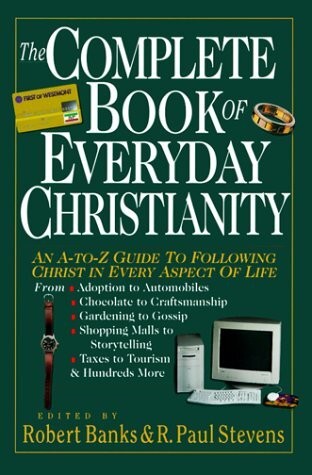
The authors Robert Banks and R. Paul Stevens have partnered with The Theology of Work Project to offer The Complete Book of Everyday Christianity in its entirety here. All rights reserved.
This resource was originally published in 1997, and the text has not been updated.